SCR’d MaxxForce 13 Now a Joy To Drive

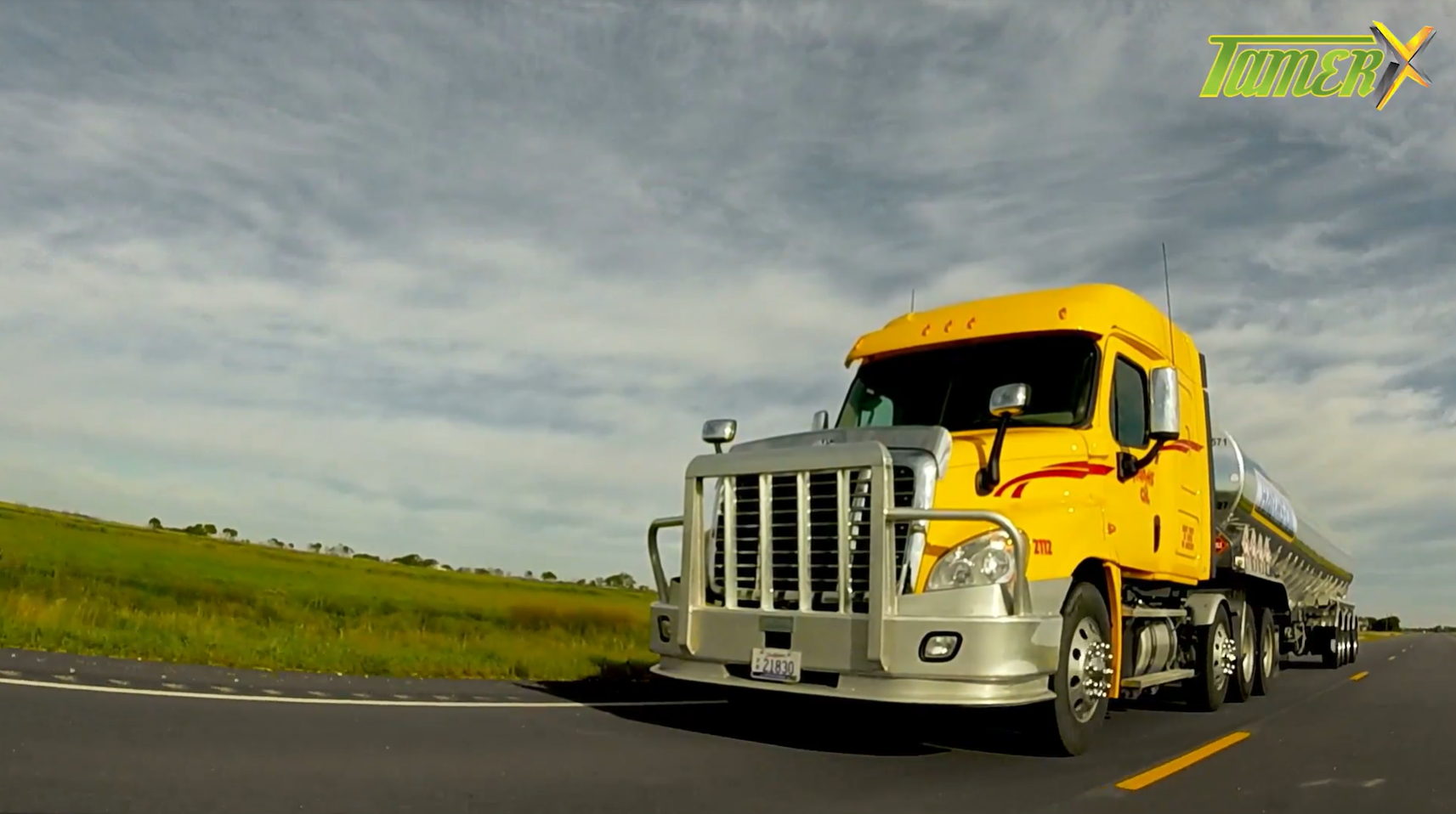
Driving the MaxxForce 13 SCR is very enjoyable.
An examination of Navistar's upgraded heavy-duty diesel models reveals positive progress. The financial issues and the engines are the two fronts on which Navistar is trying a comeback. During the drive, which took place during a show-and-tell for trade press reporters, executives and engineers at their Melrose Park, Illinois, engine factory explained more efficient development and manufacturing techniques. The renewed confidence among executives that has replaced the pushback and rival-shaming we saw and heard from previous leaders invigorated me as I departed. And I liked the sound of their engines.
Maxxforce 13 Engine
In terms of diesel exhaust emissions, Navistar took a different tack for a while, managing nitrogen oxide just in the cylinders of their engines and refusing to use urea injection, the essential component of selective catalytic reduction. All of its competitors in North America and the majority of others around the world have chosen SCR despite the fact that it adds weight and bulk to a truck. The scientists at Navistar were unable to lower NOx to levels below the rigorous government guidelines, nevertheless. Costly problems with the MaxxForce 13, the leading large engine in the market, caused a decline in sales, profitability, and stock prices.
Due to a rebellion spearheaded by sizable stockholders, Navistar's top management changed their plans, forgoing exhaust-gas recirculation in favor of SCR. Several plans for building engines and trucks had to be discontinued or sold due to financial problems. Due to the turmoil, top management also underwent a transition, with Troy Clarke—a former GM executive and engineer who had just joined Navistar—being elevated to the position of president and CEO. At the ride-and-drive event in late May near the company's headquarters in Lisle, Illinois, Clarke, a pleasant and likable man, led the low-key cheering.
The two big-bore diesels that are currently offered in Class 8 International trucks and tractors were on show by him and his colleagues. They were Navistar's own 12.4-liter MaxxForce 13 and Cummins' 15-liter ISX, which is already out of date after only a few MaxxForce 15 engines were made. Both modern engines use SCR. Due to its SCR strategy, Cummins was long barred from domestic trucks. Now, Cummins is a partner of Navistar. Engineers from Cummins were sent to Lisle and Melrose Park to help with the transition to SCR. As of right now, Cummins offers both the ISX15 and emissions-reduction equipment for Navistar's own diesel engines, starting with the MaxxForce 13.
Executives from Navistar are most zealous in advertising their own engine, notwithstanding their glowing remarks about Cummins. Sales of parts and services, in addition to those of engines, provide a higher potential for profit for the manufacturer and its dealers. During this competition, I drove four tractors, two of which had MaxxForce 13 tires and the other two had ISX15s. This allowed us to feel the differences between the two tire types. However, in this case, the smaller Navistar diesels were more exciting. Normally, bigger is better.
I started off in an International 9900i long conventional, one of my favorite brands because of its classic appearance, relaxing ride, and fun driving characteristics. However, this car was difficult to drive due to its fleet-spec Eaton 10-speed manual transmission, which was coupled with a very stiff shifting lever and a hard clutch pedal. Better component choices, especially for this kind of truck, would have included a power-assisted clutch and a 13- or 18-speed tranny. However, I could feel the engine's strength. The 475 horsepower and 1,850 lb.-ft. of torque this vehicle has even with a gross weight of almost 80,000 pounds. It was rated to go skillfully along the tollway for I-88.
Later, I boarded a ProStar+ day cab tractor with an ISX15 transmission and an Eaton UltraShift Plus self-shifter. I could now just use the accelerator and braking pedals as needed to control the vehicle. And I would appreciate the massive Cummins engine's odd 425 horsepower and 1,700 lb.-ft. of torque. more thoroughly, of the torque figure. Why would anyone buy a 15-liter engine with so poor power, despite the high torque? Our driving hosts suggested that we update the engine to increase the car's resale value because doing so might make it more appealing to a subsequent owner. Executives claim that some customers will prefer a 15 for pulling really heavy loads or in difficult terrain. The ISX15 can be specified with up to 600 horsepower and 2,050 lb.-ft. of torque in comparison to a MaxxForce 13. with torque.
I mentioned that some truckers think there's a better chance a 14 or 15-liter diesel will go a million miles without needing an overhaul. The MaxxForce 13 has a B50 life of 1.2 million miles, according to Navistar experts, meaning that at least half of the engines should last until that point without requiring any maintenance. To borrow an old adage, your results could differ. The bulk of weights can be pulled by 13-liter engines with ease in long-haul operations, and construction trucks have long used this size diesel due to its robust outputs. Truck manufacturers have been asserting that 13-liter diesels are the future since almost everyone now has one.
On this particular day, I drove two Navistar MaxxForce 13 trucks with 450 and 500 horsepower and a top torque of 1,700 lb-ft. If anyone is concerned about tare weight, executives claim that the 13 weighs around 500 pounds less than the ISX15, which offsets the 400 to 500 pounds of SCR equipment that every Class 8 vehicle will carry. In other words, although weighing 400 pounds more than its predecessor, the MaxxForce 13-powered International with SCR should be more fun to purchase and drive.
This is necessary so that Navistar engineers may switch to SCR and significantly lower the amount of exhaust gas returned to the cylinders. Engineers claim that 50% is a representative percentage, albeit exactly how much less varies in the workplace. This is important because competitors coined the phrase "large EGR" to describe Navistar's attempts to reduce NOx without urea injection. Small quantities of contaminated exhaust gas can jam the EGR valves, which regulate exhaust flow, and put a significant heat load on cooling systems. These problems must be lessened.
Executives said that the diesel particulate filter's difficulties had also diminished. Fleet managers have voiced complaints about cracked and blocked DPFs from all engine manufacturers, including Navistar, however modifying the operational software has decreased the number of active regenerations, which use fuel and place stress on the honeycomb substrate. Since January, a group of its own road tractors have driven more than 2 million miles in on-road testing of MaxxForce 13s, and higher-than-expected uptime has made an earlier completion possible. The longevity of each engine has yet to be assessed because, as of late May, they had only covered up to 125,000 kilometers.
SCR now offers better fuel economy than its competitors. This is due to the ability for engines to be tuned for both efficiency and performance when NOx is suppressed in the exhaust system. Although they could not disclose numbers, Navistar executives used the word "significantly" to describe the resulting economy. It also doesn't disclose how much gasoline and diesel exhaust fluid Navistar engines now naturally use. All lines will now begin at the exact same two pumps.
However, a driver can now notice that the throttle response is superior to MaxxForce 13s prior to SCR. I learned this while running two ProStar+ tractors fitted with MaxxForce 13 engines, since Troy Clarke had forewarned us journalists about it before we tried the engines. One of our hosts also noted that the ProStars actually drove more flawlessly than the 9900i. The 10-speed and 13-speed manual transmissions on the ProStars both functioned without issue. With a self-shifting transmission driven by a Cummins engine, I could appreciate the engines just as I had in the ProStar.
A 500 model of the MaxxForce 13 had dual torque ratings of 1,550 and 1,700 lb-ft. The other generated 1,650 lb.-ft. of torque and up to 450 horsepower. with torque. You put your foot down on the throttle and they were off. Acceleration was rapid at any road speed, and pulling power at low revs—1,000 rpm or less—was great. On numerous occasions, I saw the tachometer was at or near 900 rpm. Instead of downshifting, I simply eased onto the accelerator, which allowed the engine to accelerate smoothly. I've tried this before, beginning at 700 rpm, and the outcomes were the same: there was no shaking or missing, only torque that grew gradually as the RPM went back into the operating range. True, competing 13-liter diesels can also do this, but at 1,300 to 1,700 rpm, the Navistar seems more alive.
My coworker commented on how quiet the Navistars were, and he couldn't have been more accurate. A little snarl, though, would have been more fascinating, in my opinion. When it comes to driving exams, Northern Illinois is quite flat, so I wished there were more hills to climb. perhaps in the future. However, the MaxxForce 13 with SCR is a lot of fun to drive, which drivers should appreciate. Management will also value how well it hauls. If dependability and lifespan prove to be as exceptional as Navistar specialists and executives anticipate, this engine will increase customer fortunes and that business recovery.